Cross-Border Shipping from UAE to GCC: A Complete Guide
Girish
September 14, 2026
As an online seller in the UAE, it’s easy to streamline your shipping operations, if you’re only doing it locally.
But as your brand grows, and you start receiving more orders not only in Dubai, but also from Saudi Arabia, Kuwait or Bahrain, the stakes get higher. Even if you have the demand, the inventory and the marketing figured out, your package can still get stuck at customs or be returned because of incomplete paperwork.
If you’ve been shipping to GCC countries, chances are you’ve already navigated these challenges as an eCommerce seller. Yes, opportunity is big but so is the complexity. Each country has its own systems, and customs regulations.
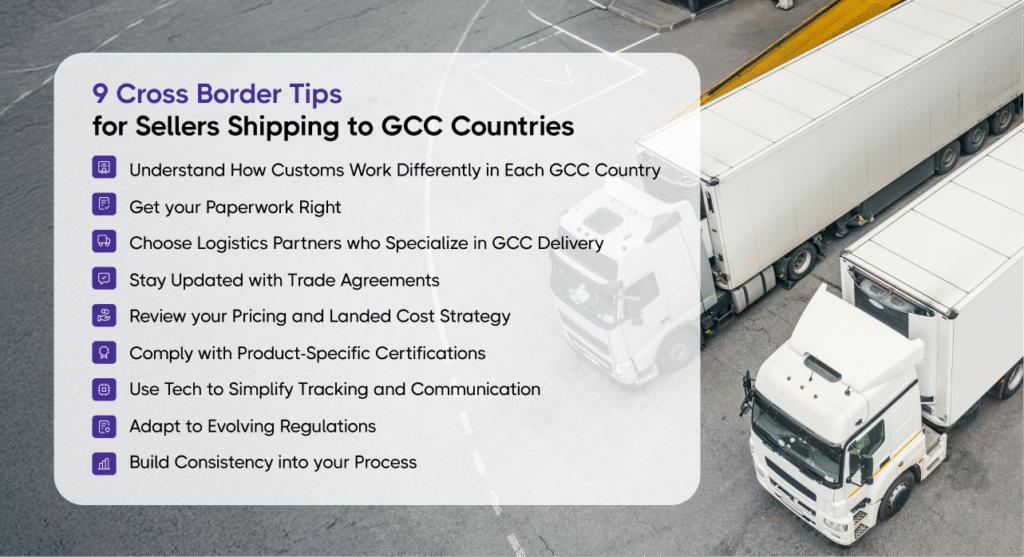
9 Cross Border Tips for Sellers Shipping to GCC Countries
To help you with cross-border shipping, here are 9 tips for you as UAE eCommerce seller, that will simplify the process for you, from documentation to the last-mile delivery, across GCC countries.
1. Understand How Customs Work Differently in Each GCC Country
The UAE may be a part of the GCC, but the shipping process for each country differs. For instance, Saudi Arabia has its own product registration system. Oman may have different clearance times. Bahrain might require specific labeling or certificates depending on your product.
So, if you’re selling beauty and wellness products, Saudi Arabia may require you to register them in SABER. For electronics, Qatar might need local compliance documentation. These aren’t always hard to get, but you do need to know about them before you ship.
You can refer to official sources like the Gulf Standardization Organization, Zakat, Tax and Customs Authority (KSA), and UAE Federal Customs Authority to stay updated about the latest requirements.
2. Get your Paperwork Right
Customs clearance depends on how thorough your documentation is. Even if one detail is out of line, whether it is your invoice details or a wrong HS code, it can cause unnecessary delays for your shipment.
Your customs checklist should include the following:
A commercial invoice with correct HS codes
Certificate of origin
Packing list
Any required product certifications
If you are shipping food, cosmetics, electronics or supplements, the documentation might vary from country to country.
It is your responsibility as an eCommerce seller, to double-check what’s required before you dispatch the shipment to your customers. Avoid assumptions that your courier or freight forwarder will ensure the necessary customs checks for you. They may help you in processing your orders but that doesn’t guarantee accuracy.
With a platform like eShipper UAE though, you can get access to expert support to minimize paperwork-related errors and significantly reduce clearance delays.
3. Choose Logistics Partners who Specialize in GCC Delivery
Not all carriers that serve the UAE are equipped to handle regional cross-border logistics. Local deliveries and cross-border fulfillment are two different things.
For instance, if you are shipping furniture to Oman or temperature-sensitive items like beauty products to Kuwait, you need a carrier partner who understands how to route, document and deliver those shipments without these get held at customs. That includes bonded warehousing, customs pre-clearance and a strong last-mile delivery network in that GCC country.
This is where experience in international shipping becomes critical. Partnering up with a multi-carrier platform like eShipper UAE which has a trusted carrier network across the GCC, can give you various fulfillment options and end-to-end visibility so you can deliver across the GCC region without any disruptions.
4. Stay Updated with Trade Agreements
Trade regulations between the UAE and other GCC countries constantly change. Take for example, tariff exemptions. These may apply for goods produced within the GCC under a unified customs law. But to qualify, your shipments must meet the rules of origin and be properly documented.
Missing out on these benefits means you could be overpaying on duties or taxes as a UAE eCommerce seller. To avoid this, it is always advisable to check with the UAE Ministry of Economy or the GCC Secretariat for the latest updates on trade agreements and their impact on eCommerce exports.
5. Review your Pricing and Landed Cost Strategy
It’s one thing to price your product for the UAE market. It’s another to factor in international shipping, customs duties, VAT and possible returns.
Before you list a product as ‘available’ in the GCC, make sure you calculate the full landed cost. That includes:
Shipping and handling fees
Customs duties at destination
VAT rates (typically 5 percent but can vary)
Return handling costs
You can then use this data to build a pricing strategy that protects your margins without surprising your customers at checkout.
eShipper UAE offers landed cost calculators and rate tools to help you offer competitive prices to your customers.
6. Comply with Product-Specific Certifications
If you are a UAE seller, selling food, beverages, cosmetics or supplements, your goods may need ‘Halal’ certification to clear certain borders. This is especially true when shipping to Saudi Arabia, where non-compliant goods are often rejected.
Make sure your products are certified by an approved halal body recognized in the destination country. For cosmetics and supplements, look at additional certifications such as SFDA (Saudi Food and Drug Authority) approvals.
7. Use Tech to Simplify Tracking and Communication
As your cross-border volume grows, so does the need for operational visibility. A manual system might work for a few shipments a week, but not when you are scaling to multiple GCC markets.
Use a centralized shipping dashboard that can help you:
With eShipper UAE’s all-in-one dashboard, you can streamline every step of the international shipping process from quote to global delivery.
8. Adapt to Evolving Regulations
GCC regulations are constantly evolving. In the past few years, there have been changes to VAT enforcement, product classification and customs clearance workflows. If you’re not paying attention, it’s easy to fall behind.
Make sure you receive constant updates from your logistics partner or sign up for alerts from customs authorities in key GCC countries. This will allow you to proactively adjust your operations instead of reacting to disruptions at the last minute.
9. Build Consistency into your Process
If you want to grow your cross-border sales, your operations have to be reliable and need to follow a uniform shipping process from the first mile to the last. Set up internal checklists for documentation. Keep copies of approved customs paperwork. Train your team to use the same product naming conventions and descriptions each time.
This consistency will help you speed up clearance, reduce errors and helps your logistics partner, support you more effectively.
With a platform like eShipper, you as a UAE seller, can implement standardized workflows from day one.
Key Takeaways for Successful Cross-Border Shipping in the GCC
Here’s the key takeaways for Cross Border Shipping:
Understand the customs requirements for each GCC country.
Double-check your shipping documentation and use correct HS codes.
Work with specialized logistics partners like eShipper UAE for GCC deliveries.
Stay updated with trade regulations and exemptions.
Accurately calculate landed costs before listing products.
Ensure product compliance and necessary certifications, including halal.
Use centralized tech for tracking, communication, and automation.
Monitor evolving regulations and adapt your processes accordingly.
Standardize your workflows to avoid delays and reduce errors.
Conclusion
Shipping from the UAE to GCC countries is full of potential, but it requires attention to detail. Customs, documentation, regulations and delivery expectations can vary more than many sellers realize. But with the right setup, partners, paperwork and processes, you can scale your business across the Gulf with far less friction.
Whether you’re just starting out or ready to expand into multiple GCC markets, a multi-carrier platform like eShipper UAE can help you ship smarter, stay compliant and grow faster.
As a UAE eCommerce seller, the holiday season can feel like navigating a complex maze. Demand spikes, courier surcharges, public holidays, and last-minute orders all add pressure to your logistics operations. Without careful planning, you risk delayed shipments, unhappy customers, and missed revenue opportunities. In this guide, we’ll walk you through smart shipping strategies to help […]
Learn how FOB, EXW, and CIF work for UAE businesses. Understand responsibilities, costs, and risks in international shipping to make informed logistics decisions.
eshipperuae
5 mins read
We'll send more eCommerce insights, tips, and inspiration straight to your inbox.
Thank you for reaching out!
We have received your information and will get back to you soon.